同期と隔週土曜に CryptoHack の問題を解いている。
-
2024-09-14 登録
-
pemfrom Crypto.PublicKey import RSAkey = RSA.import_key(key), key.d
-
pub keyは公開されていて検索できる, 使っているsub domainを検索
openssl rsa -in t.pem -pubin -outform der | openssl dgst -sha256- https://crt.sh?a=1 で
SHA-256(SubjectPublicKeyInfo)で検索 https://thetransparencyflagishere.cryptohack.org/がヒットする
Math
- Legendre Symbol
- Successive Powers
# x^a, x^(a+1), ... (mod p) の列から a, pを特定
ints = [588, 665, 216, 113, 642, 4, 836, 114, 851, 492, 819, 237]

# 以下 mod p
# x ^ a = 588
# x ^ a * x = 588 * x = 665 <=> x = 665 / 588
# x ^ a * x ^ 2 = 588 * x ^ 2 = 216 <=> x ^ 2 = 216 / 588
# よって, 216 / 588 = (665 / 588) ^ 2

for p in range(100, 999):
    try:
        if divmod(216, 588, p) == pow(divmod(665, 588, p), 2, p):
            ic(p)
            break
    except:
        pass

ic(divmod(665, 588, p))
- Adrien’s Signs
- 有限体の累乗根: Adleman-Manders-Miler algorithm
# c = 01100011
# [0]: n1 = a ^ e1
# n1 = -878604477115251
# [3]: n3 = a ^ e3
# n3 = -384763565929640
# n1 * n3 = a ^ (e1 + e3)

# 方針: e乗根を求める
for i in range(1, 8):
    for b in ["0", "1"]:
        # TODO: 主張: b が 1 か 0 かどちらかの場合のみ e乗根が存在する
        if b == "1":
            actual_n = actual_ints[i]
        else:
            actual_n = -actual_ints[i] % p

        # e乗根の存在を確認
        # a = actual_n ^ e mod p
        e = discrete_logarithm_arbitrary_mod(a, actual_n, p)
        ic(i, b, e)
        if e is None:
            continue
        ans.append(b)

ic(ans)

ic(long_to_bytes(int("".join([str(int(qr(i, p))) for i in c]), 2)))-
日本90位
-
Modular Binomials
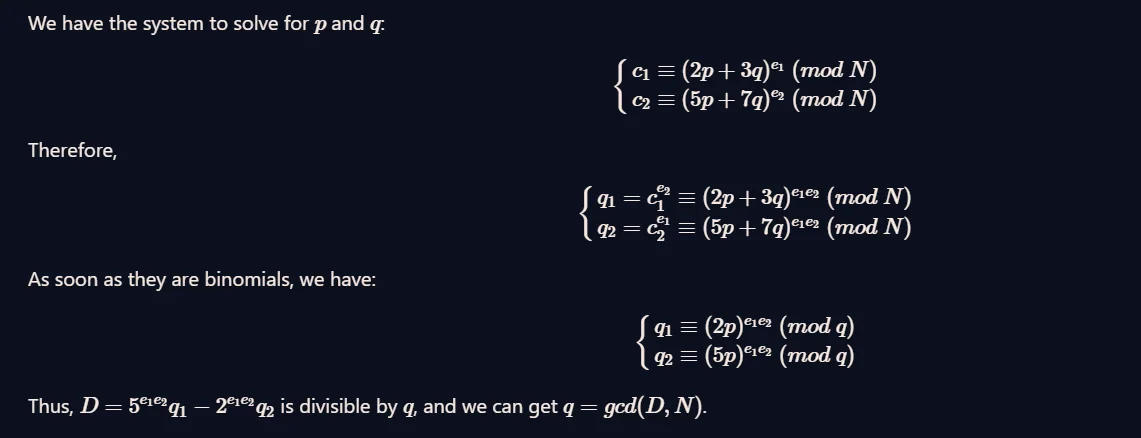
# e1, e2, c1, c2, n given
e = e1 * e2

# c1^e2 = (2p)^e + (3q)^e
# c2^e1 = (5p)^e + (7q)^e
# p^e を消す, 5^e c1^e2 - 2^e c2^e1 = (q だけの式)
# よって q^e は (左辺) をNの約数に持つ
# q^e = q = gcd((左辺), N)

e = e1 * e2
q = gcd(pow(5, e, n) * pow(c1, e2, n) - pow(2, e, n) * pow(c2, e1, n), n)
p = n // q
assert n == p * q
print(f"crypto{{{p},{q}}}")- Broken RSA
Symmetric Ciphers
- Biclique attack - Wikipedia
- AES
- ECB mode
- 再生攻撃
Passwords as keys
key <- md5(word.encode())
flag = "crypto{???}"
ct = aes.enc(key, flag)
{ word in words | aes.dec(key, ct) == "crypto{...}" }
ECB CBC WTF
[iv, ct] = aes.enc(key, flag, iv)
[iv: 16 | ct1: 16 | ct2: 16]
# inversion of CBC
p2 = dec(c2) ^ c1
p1 = dec(c1) ^ iv
p = p1 + p2
print(p)
-
ECB Oracle- AES-ECB Padding Attack | Exploit Notes
- 31bytesのダミーで埋めると先頭1(=32-1)byteのみの暗号化となる
- 総当りで1bytesを探す, 以降30byte + 見つけた1byte(=flag)に減らして同じことをする
-
Flipping Cookie
# p1_true = p1 ^ "admin=False;expi" ^ "admin=True ;expi"
# c1 = enc(p1 ^ iv)
# c2 = enc(p2 ^ c1)
# c3 = enc(p3 ^ c2)
RSA
-
素因数分解
- ECM: Eliptic Curve Method
- SIQS: 2次篩
-
Modular Exponentiation -
Publis Keys- `n = p*q
ct = pow(pt, e, n)
-
Euler's Totient- 約数の個数
phi(N) = (p-1)(q-1)- p, q: 素数なので
-
Private Keyspt = pow(ct, d, n)d = pow(e, -1, phi)
-
RSA Decryption -
RSA Signatures- 平文
m, `c = pow(m, e0, N0) - 署名
s = pow(h(m), d1, n1)h()はSHA256
- 検証
s == pow(s, e1, n1)
- 平文
-
Factoring -
Inferius Prime -
Monoprime- n: 素数のとき
phi = n - 1
- n: 素数のとき
-
Square Eyesn = p * pmath.isqrtあった
phi(p^k) = p^k - p^k-1になるらしい- オイラーのファイ関数とモジュラ逆数 | 情報科 いっぽ まえへ!
-
Manyprime- factordb
-
Salty- やるだけ
-
Modulus Inutilis- Low Public-Exponent Attack ctf - Qiita
gmpy2.iroot(v^k, k) -> (mpz(v), is_int)pt^e < nの時, mod n の影響受けなくなるのでpt = iroot(ct, e)
-
Everything is Big- factordb
-
Crossed Wires- factordb
- 順番にdecするだけ
-
Everything is still Big- factordb
-
Endless Emails- 同じ平文を異なるNで暗号化
- Håstad’s Broadcast Attack
- RSA 暗号を理解して有名な攻撃を試してみる
- Håstad’s broadcast attack security - Qiita
- 3つの組み合わせで総当りして
irootがあるものを選ぶ
def CRT(pairs):
    M = 1
    for a, m in pairs:
        M *= m
    result = 0
    for a, m in pairs:
        Mi = M // m
        s, _, _ = extgcd(Mi, m)
        result += a * Mi * s
    return result % M

def HBR(e: int, pairs: list[(int, int)]):
    r = CRT(pairs)
    return iroot(r, e)

for indices in combinations(range(len(cn_pairs)), 3):
    pairs = [cn_pairs[i] for i in indices]
    pt, is_int = HBR(e, pairs)
    if is_int:
print(long_to_bytes(pt))-
日本62位
-
Infinite Descent- factordb
-
Marin's Secrets- factordb
-
Fast Primeskey = RSA.construct((n, e, d))cipher = PKCS1_OAEP.new(key)
-
Ron was Wrong, Whit is Right
Diffie-Hellman
-
H = Fp^* = g^n mod p -
Generator of Groups
-
Computing Public Values
-
Parameter Injection
nc socket.cryptohack.org 13371- Bで
0x01を送ればkey=pow(B, a, p) = 1になる
-
Export Grade
- DH64なら離散対数問題解けそう?
- baby-step_giant-stepアルゴリズム
- GitHub - shainer/baby-step: Implementation of the baby-step, giant-step algorithm for finding discrete logarithms
- → 遅かったし答え違った
from sympy.ntheory import discrete_logが早かった
- 平方分割
-
Static Client2
- pがあまりコントロール出来ない
- 1536bit以上なら通った
- p-1が小さいに素因数に分解できない
- small subgroup attack出来ない
- Write up [Cryptohack] Static Client - Static Client2 - HackMD
- -> 危険なpを渡せば良かった
- p-1がN以下の素因数に分解できるpをN-Smooth numberと言うらしい
- 構成
- prod p (p < n, p: 素数, 小さい順) + 1 が合成数ことは絶対にない?
- → いいえ, 2×3×5×7×11×13+1=30031=59×509
- prod p (p < n, p: 素数, 小さい順) + 1 が合成数ことは絶対にない?
- smooth-numberを探す
- rfc/DH group.md at master · pingu342/rfc · GitHub
- TLSとDiffie-Hellmanグループパラメータ security - Qiita
- 2048-bit MODP Group with 224-bit Prime Order Subgroup
- pがあまりコントロール出来ない
from Crypto.Util.number import *


def smooth_p():
    mul = 1
    i = 1
    while 1:
        mul *= i
        if (mul + 1).bit_length() >= p.bit_length() and isPrime(mul + 1):
            return mul + 1
        i += 1
Elliptic Curves
-
ECDSA: ECなDSA(デジタル署名)
-
Background Reading
- E:
Y^2 = X^3 + aX +b- 非特異なら判別式
4a^3 + 27b^2 != 0を満たす wikipedia- 特異点: 尖っている部分
- 非特異なら判別式
- EC上の点で演算
- 2点を通る直線とECの交点が結果
- 無限遠点を0
- P + (-P) = 0 垂直になる
- P + P は接線
- nPからPを求めるのが難しい
- ECDLP
- Pがq個の部分群作る時
- ECDLP
- 有限体上の楕円曲線を考える
- E:
-
Point Negation
E(Fp) = {(x, y) in (Fp, Fp) | {e in E, O}}
-
Curves and Logs
- 安全のため 生成元 G の位数が素数であるべき
def sha1(s: str):
    import hashlib

    sha1 = hashlib.sha1()
    sha1.update(s.encode("ascii"))
    hash = sha1.digest()
return hash- ECDH
alice:
    n_A <- Z
    Q_A = [n_A]G
bob:
    n_B <- Z
    Q_B = [n_B]G
alice:
    [n_A]Q_B
bob:
    [n_B]Q_A

S = [n_A]Q_B = [n_B]Q_A
- Efficient Exchange
from lib import fp, EllipticCurve, Point, decrypt_flag

ec = EllipticCurve(fp(497), fp(1768))
g = Point.new(1804, 5368)

x = fp(4726)
q_a = Point(False, x, ec.e(x))
n_b = 6534
s = ec.mul(q_a, n_b).x
print(decrypt_flag(s.value, iv, encrypted_flag))sage: p = 310717010502520989590157367261876774703
sage: p
310717010502520989590157367261876774703
sage: a = 2
sage: b = 3
sage: g_x = 179210853392303317793440285562762725654
sage: g_y = 105268671499942631758568591033409611165
sage: E = EllipticCurve(GF(p), [a,b])
sage: G = E(g_x, g_y)
sage: G.order()
155358505251260494795103074529582338902
sage: n = G.order()
sage: n.factor()
2 * 3^7 * 139 * 165229 * 31850531 * 270778799 * 179317983307
sage: gn_x = 280810182131414898730378982766101210916
sage: gn_y = 291506490768054478159835604632710368904
sage: Gn = E(gn_x, gn_y)
sage: G.discrete_log(Gn)-
Exceptional Curves
from sage.all import出来ない
-
Micro Transmissions
Hash Functions
-
(1) Pre-image attacks
x = hash(m)があるときに,hash(m0) == xとなるm0を見つけることが難しい
-
(2) Second pre-image resistance
m1があるときにhash(m1) == hash(m2)を探すのが難しい- (1) が出来るなら出来る
-
(3) Collision resistance
hash(m1) == hash(m2)なm1, m2を見つけるのが難しい- (1) が出来るなら出来る
- (3) が出来ても (1) が出来るとは限らない
-
Jack’s Birthday Hash
- 11bit値
JACK(secret) = 01011001101と衝突する確率が50%になる秘密鍵の個数は? - -> 誕生日攻撃は2つ用意できるので違う
- 余事象をつかう
(1 - 2^-11)^n > 0.5 <=> n > 1420
- 11bit値
-
Jack’s Birthday Confusion
- 任意の2つが75%
k ~= sqrt(2n ln(1 / 1 - p)) = sqrt(2n ln 4)
-
Collider
self.documents[document_hash] != documentだとflagわかる
-
Hash Stuffing
- xorと巡回シフトが全単射な気がするので無理でない?
initial_stateを普通に使いまわしていた
- bitの流れを追う
- byteをGF(256), 64bytesを
x1~x64とおいて計算 - CryptoHack – Login
- byteをGF(256), 64bytesを
- xorと巡回シフトが全単射な気がするので無理でない?
-
Merkle Trees
- やるだけ
-
WOTS Up
Web Security
RSA or HMAC2
https://blog.silentsignal.eu/2021/02/08/abusing-jwt-public-keys-without-the-public-key/
- なぜ差分のgcdでN求められる?
- https://github.com/silentsignal/rsa_sign2n/blob/2b1ef110741be7640a1c2b5679ee239f0e215e9f/CVE-2017-11424/x_CVE-2017-11424.py#L79
gcd(pow(jwt0_sig, e) - m0, pow(jwt1_sig, e) - m1)- jwt0_sig はmpzじゃないので gcd(kn, ln) になる
- RS256: で署名、 で検証
TLS
$ tshark -r ~/Downloads/cryptohack_6b3a90f7c585d399088758fda92fb9f6.org.pcapng
# DNS
    1   0.000000 172.16.112.134 → 172.16.112.2 DNS 74 Standard query 0x87f0 A cryptohack.or
    2   0.000117 172.16.112.134 → 172.16.112.2 DNS 74 Standard query 0x2bf6 AAAA cryptohack.org
# The "Safe Browsing" feature in Firefox reached out to a Google server
# to check that cryptohack.org was not a phishing or malicious domain.
    3   0.007451 172.16.112.134 → 216.58.213.3 TCP 54 56062 → 80 [ACK] Seq=1 Ack=1 Win=63791 Len=0
    4   0.008528 216.58.213.3 → 172.16.112.134 TCP 60 [TCP ACKed unseen segment] 80 → 56062 [ACK] Seq=1 Ack=2 Win
# DNS responses
    5   0.170777 172.16.112.2 → 172.16.112.134 DNS 104 Standard query response 0x87f0 A cryptohack.org A 178.62.7
    6   0.172908 172.16.112.2 → 172.16.112.134 DNS 169 Standard query response 0x2bf6 AAAA cryptohack.org SOA ns1
# A TCP three-way handshake
    7   0.175626 172.16.112.134 → 178.62.74.206 TCP 74 54028 → 443 [SYN] Seq=0 Win=64240 Len=0 MSS=1460 SACK_PERM
    8   0.185694 178.62.74.206 → 172.16.112.134 TCP 60 443 → 54028 [SYN, ACK] Seq=0 Ack=1 Win=64240 Len=0 MSS=146
    9   0.186029 172.16.112.134 → 178.62.74.206 TCP 54 54028 → 443 [ACK] Seq=1 Ack=1 Win=64240 Len=0
# A TLS ClientHello
   10   0.207390 172.16.112.134 → 178.62.74.206 TLSv1 571 Client Hello
   11   0.209439 178.62.74.206 → 172.16.112.134 TCP 60 443 → 54028 [ACK] Seq=1 Ack=518 Win=64240 Len=0
# The server sent TLS ServerHello
   12   0.217279 178.62.74.206 → 172.16.112.134 TLSv1.3 2934 Server Hello, Change Cipher Spec, Application Data
   13   0.217366 172.16.112.134 → 178.62.74.206 TCP 54 54028 → 443 [ACK] Seq=518 Ack=2881 Win=62780 Len=0
   14   0.217280 178.62.74.206 → 172.16.112.134 TCP 1270 443 → 54028 [PSH, ACK] Seq=2881 Ack=518 Win=64240 Len=12
   15   0.218063 172.16.112.134 → 178.62.74.206 TCP 54 54028 → 443 [ACK] Seq=518 Ack=4097 Win=61564 Len=0
   16   0.218534 178.62.74.206 → 172.16.112.134 TLSv1.3 582 Application Data, Application Data, Application Data
   17   0.218591 172.16.112.134 → 178.62.74.206 TCP 54 54028 → 443 [ACK] Seq=518 Ack=4625 Win=61036 Len=0
# An Online Certificate Status Protocol (OCSP) connection was made from our laptop to an OCSP server,
# to check that the TLS certificate presented by CryptoHack hadn't been revoked...
   18   0.255769 172.16.112.134 → 23.62.3.195  OCSP 467 Request
   19   0.256280  23.62.3.195 → 172.16.112.134 TCP 60 80 → 38256 [ACK] Seq=1 Ack=414 Win=64240 Len=0
   20   0.265894  23.62.3.195 → 172.16.112.134 OCSP 941 Response
   21   0.265949 172.16.112.134 → 23.62.3.195  TCP 54 38256 → 80 [ACK] Seq=414 Ack=888 Win=63936 Len=0
# Our laptop sent a Change Cipher Spec message to note that it is switching over to sending encrypted data
   22   0.278679 172.16.112.134 → 178.62.74.206 TLSv1.3 134 Change Cipher Spec, Application Data
   23   0.279032 178.62.74.206 → 172.16.112.134 TCP 60 443 → 54028 [ACK] Seq=4625 Ack=598 Win=64240 Len=0
   24   0.280042 172.16.112.134 → 178.62.74.206 TLSv1.3 224 Application Data
   25   0.280460 172.16.112.134 → 178.62.74.206 TLSv1.3 361 Application Data
   26   0.280537 178.62.74.206 → 172.16.112.134 TCP 60 443 → 54028 [ACK] Seq=4625 Ack=768 Win=64240 Len=0
   27   0.280658 178.62.74.206 → 172.16.112.134 TCP 60 443 → 54028 [ACK] Seq=4625 Ack=1075 Win=64240 Len=0
   28   0.288327 178.62.74.206 → 172.16.112.134 TLSv1.3 690 Application Data, Application Data, Application Data
# The server started sending the contents
   29   0.288356 172.16.112.134 → 178.62.74.206 TCP 54 54028 → 443 [ACK] Seq=1075 Ack=5261 Win=62780 Len=0
   30   0.288742 172.16.112.134 → 178.62.74.206 TLSv1.3 85 Application Data
   31   0.288994 178.62.74.206 → 172.16.112.134 TCP 60 443 → 54028 [ACK] Seq=5261 Ack=1106 Win=64240 Len=0
   32   0.296851 178.62.74.206 → 172.16.112.134 TLSv1.3 85 Application Data
   33   0.296881 172.16.112.134 → 178.62.74.206 TCP 54 54028 → 443 [ACK] Seq=1106 Ack=5292 Win=62780 Len=0
   34   0.347798 178.62.74.206 → 172.16.112.134 TCP 1494 [TCP segment of a reassembled PDU]
   35   0.347839 172.16.112.134 → 178.62.74.206 TCP 54 54028 → 443 [ACK] Seq=1106 Ack=6732 Win=62780 Len=0
   36   0.348229 178.62.74.206 → 172.16.112.134 TCP 1494 443 → 54028 [PSH, ACK] Seq=6732 Ack=1106 Win=64240 Len=1440 [TCP segment of a reassembled PDU]
   37   0.348266 172.16.112.134 → 178.62.74.206 TCP 54 54028 → 443 [ACK] Seq=1106 Ack=8172 Win=62780 Len=0
   38   0.349329 178.62.74.206 → 172.16.112.134 TLSv1.3 2556 Application Data
   39   0.349369 172.16.112.134 → 178.62.74.206 TCP 54 54028 → 443 [ACK] Seq=1106 Ack=10674 Win=62780 Len=0
# Firefox's HTML parser saw that it needed external resources from Content Delivery Networks
   40   0.622776 172.16.112.134 → 172.16.112.2 DNS 80 Standard query 0xe81a A cdnjs.cloudflare.com
   41   0.622859 172.16.112.134 → 172.16.112.2 DNS 80 Standard query 0xda07 AAAA cdnjs.cloudflare.com
   42   0.625105 172.16.112.134 → 172.16.112.2 DNS 74 Standard query 0x8b91 A cryptohack.org
   43   0.625316 172.16.112.134 → 172.16.112.2 DNS 74 Standard query 0x7c9d AAAA cryptohack.org
   44   0.635045 172.16.112.2 → 172.16.112.134 DNS 90 Standard query response 0x8b91 A cryptohack.org A 178.62.74.206
   45   0.637084 172.16.112.2 → 172.16.112.134 DNS 74 Standard query response 0x7c9d AAAA cryptohack.org
   46   0.643725 172.16.112.2 → 172.16.112.134 DNS 152 Standard query response 0xe81a A cdnjs.cloudflare.com A 104.16.19.94 A 104.16.18.94
   47   0.645859 172.16.112.2 → 172.16.112.134 DNS 176 Standard query response 0xda07 AAAA cdnjs.cloudflare.com AAAA 2606:4700::6810:135e AAAA 2606:4700::6810:125e
   48   0.669092 172.16.112.134 → 172.16.112.2 DNS 76 Standard query 0x296c A cdn.jsdelivr.net
   49   0.669156 172.16.112.134 → 172.16.112.2 DNS 76 Standard query 0x5669 AAAA cdn.jsdelivr.net
   50   0.686745 172.16.112.2 → 172.16.112.134 DNS 333 Standard query response 0x5669 AAAA cdn.jsdelivr.net CNAME jsdelivr.map.fastly.net AAAA 2a04:4e42:400::485 AAAA 2a04:4e42:200::485 AAAA 2a04:4e42:600::485 AAAA 2a04:4e42::485
   51   0.687751 172.16.112.2 → 172.16.112.134 DNS 285 Standard query response 0x296c A cdn.jsdelivr.net CNAME jsdelivr.map.fastly.net A 151.101.65.229 A 151.101.1.229 A 151.101.193.229 A 151.101.129.229
cipher suite name(OpenSSL format)
ECDHE-RSA-AES128-GCM-SHA256:ECDHE: used for key exchange.RSA: signature algorithmsAES-128: is used to symmetrically encrypt the application data.GCM: is the mode of operation that will be used for AES.
SHA256will be used for handshake authentication.
https://www.ssllabs.com/ssltest/analyze.html?d=tls1.cryptohack.org
ECDHE-RSA-AES256-GCM-SHA384
Decrypting TLS1.2
- TLS1.2はハンドシェイクが平文で見える
- Menu > Protocols > TLS > add private keys >
172.16.112.2:443
- Menu > Protocols > TLS > add private keys >
Decrypting TLS1.3
- TLS 1.3接続を復号化するには、共有マスター・シークレットの生成に使われたパラメータが必要
- (Pre)-Master-Secret logfileを指定
Authenticated Handshake
認証は
- 証明書
- 証明書の検証
- FinishedMessage: 今までのTLSメッセージのどれかが改ざんされていないかの確認
HMAC(finished_key, Transcript-Hash(Handshake Context, Certificate*, CertificateVerify*))HMAC(): cipher suiteで定義された関数, usually SHA256 or SHA384.
finished_key: is the relevant handshake_traffic_secret, theCLIENT_HANDSHAKE_TRAFFIC_SECRETseen in the keylogfile.txt in the case for the client’s Finished.Transcript-Hash(): concatenating together TLS messages (not including record layer headers) and hashing the result using the hash algorithm in the cipher suite.